|
The Air Force is now ready to concede that many saucer and
fireball sightings still defy explanation; here LIFE offers some
scientific evidence that there is a real case for interplanetary
saucers.
|
|
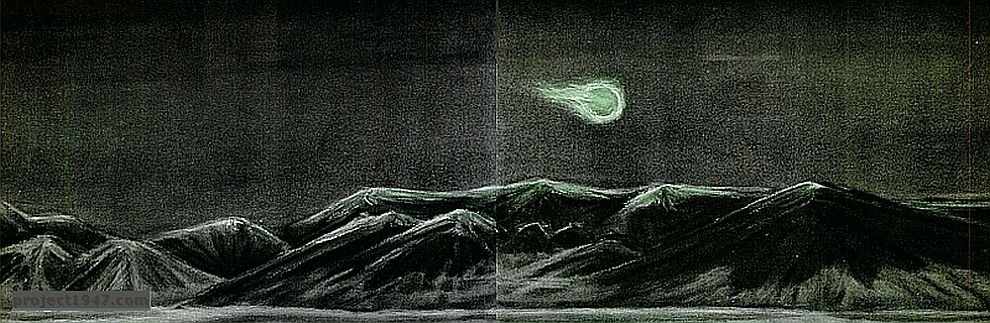
This is a scrupulously accurate eyewitness painting of a mysterious green fireball rushing through the night sky over New Mexico. It was done by Mrs. Lincoln LaPaz, wife of an authority on meteors. Both she and her husband have observed the fireballs at first hand.
FOR four years the U.S. public has wondered, worried or smirked over the strange and insistent tales of eerie objects streaking across American skies. Generally the tales have provoked only chills or titters, only rarely, reflection or analysis.
Last week the U.S. Air Force made known to LIFE the
following facts:
These disclosures, sharply amending past Air Force policy, climaxed a
review by LIFE, with Air Force officials, of all facts known in the
case. This review has resulted from more than a year of sifting and
weighting all reports of unexplained aerial phenomena – from the
so-called flying saucers to the mysterious green fireballs so often
sighted in the Southwest. This inquiry has included scrutiny of hundreds
of reported sightings, interviews with eyewitnesses across the country and
careful reviews of the facts with some of the world's ablest physicists,
astronomers, and experts on guided missiles. For the first time the Air
Force (while in no way identifying itself with any particular conclusions)
has opened its files for study.
Out of this exhaustive inquiry these propositions seem firmly shaped
by the evidence:
• 1. Disks, cylinders and similar objects of geometrical form,
luminous quality and solid nature for several years have been, and
may be now, actually present in the atmosphere of the earth.
• 2. Globes of green fire also, of a brightness more intense than the full moon's, have frequently passed through the skies. • 3. These objects cannot be explained by present science as natural phenomena — but solely as artificial devices, created and operated by a high intelligence. • 4. Finally, no power plant known or projected on earth could account for the performance of these devices.
Let us first review some widely known facts.
The shapes and inscrutable portents of the flying disks first broke
upon the skies of the world in the early months of 1947, with
several sightings reported to the Air Force. The story first
reached the nation on June 24, 1947, when a private pilot named
Kenneth Arnold was flying from Chehalis to Yakima, Wash. Some 25
miles away, Arnold saw nine "saucerlike things...flying like
geese in a diagonal chainlike line," approaching Mount
Rainier. They swerved in and out of the high peaks at a speed
Arnold estimated to be 1,200 mph.
Arnold told the whole story to his hometown newspaper, and like summer
lightning it flashed across the country. Within a month, saucers had been
reported by people in 40 states. For the public (as LIFE
itself merrily reported in its issue of July 21, 1947) he saucers
provided the biggest game of hey-diddle-diddle in history. Any man,
woman, or child with talent enough to see spots before his eyes
could get his name in the newspaper.
Nevertheless in serious moments most people were a little worried by
all the "chromium hubcaps," "flying washtubs"
and "whirling doughnuts" in the sky. Buried in the heap
of hysterical reports were some sobering cases. One was the
calamity that befell Air Force Captain Thomas F. Mantell on Jan. 7,
1948. That afternoon Mantell and two other F-51 fighter pilots
sighted an object that looked like "an ice-cream cone topped
with red" over Godman Air Force Base and Fort Knox, Ky.
Mantell followed the strange object up to 20,000 feet and
disappeared. Later in the day his body was found in a nearby field,
the wreckage of his plane scattered for a half mile around. It now
seems possible that Mantell was one of the very few sighters who
actually were deceived by a Skyhook balloon, but the incident is
still listed as unsolved by the Air Force files.
There was no such easy explanation for the strange phenomenon
observed at 2:45 a.m. on July 24, 1948 by two Eastern Air Lines
pilots. Captain Clarence S. Chiles and Copilot John B. Whitted were
flying in bright moonlight near Montgomery, Ala. when they suddenly
saw "a bright glow" and a "long rocket-like ship"
veer past them. They subsequently agreed that it was a
"wingless aircraft, 100 feet long, cigar-shaped and about twice
the diameter of a B-29, with no protruding surfaces, and two rows of
windows. . .From the sides of the craft came an intense, fairly
dark blue glow. . .like a fluorescent factory light." They
said the weird craft "pulled up with tremendous burst of flame
from the rear and zoomed into the clouds at about 800 miles an
hour," rocking their DC-3 with its "prop or jet
wash."
Just as inexplicable was the experience of Lieut. George Gorman of
the North Dakota Air National Guard. On Oct. 1, 1948 Gorman was
coming in at dusk to land his F-51 at Fargo, when he saw an intense,
bright light pass 1,000 yards away. Curious, Gorman followed the
light and saw that it seemed to be attached to nothing. For 27
hair-raising minutes Gorman pursued the light through a series of
intricate maneuvers. He said it was about 6 inches in diameter and
going faster than his F-51 (300-400 mph). It made no sound and left
no exhaust trail. After Gorman landed, the light having suddenly
flashed away in the upper air, he found support for his story –
the chief of the control tower had followed the fantastic "combat"
with binoculars.
The occurrences, jarring though they must have been to the
participants, left the official calm of the Air Force unruffled.
The project set up to investigate the saucers ("Project
Sign," known to the press as "Project Saucer") seemed
to have been fashioned more as a sedative to public controversy than
as a serious inquiry into the facts. On Dec. 27, 1949, after two
years of operation, Project Saucer wrote off all reports of
unidentified aerial phenomena as hoaxes, hallucinations or
misinterpretations of familiar objects — that is, all but 34.
These stubborn 34, seemingly unexplainable, were briskly dismissed
as psychological aberrations.
While these assurances appeased most of the press and pacified the
public, some elements in the Air Force just about this time began to
worry a bit more seriously. Saucer reports continued to come in a
rate of about one a day and were handled under the code name of
"Project Grudge." Officers at policy level began to show
concern. "The higher you go in the Air Force," conceded
one Intelligence officer, "the more seriously they take the
flying saucers."
There was good reason to be serious. As review of all records has shown,
these years have produced literally dozens of incidents defying simple
explanation — and provoking the most incredible questions.
Checked and rechecked, 10 cases out of the formidable list on record
are here presented in essential detail. Of these, three were discovered
in the course of LIFE's own investigation and are reported
for the first time.
|

|
THE LUBBOCK LIGHTS, flying in formation, are considered by
the Air Force the most unexplainable phenomena yet observed. These
photographs were made at Lubbock, Texas, on
August 30th, 1951 by Carl Hart, Jr.
Scientists say lights were not natural objects, but they
traveled too fast and too soundlessly for known machines.
INCIDENT 1
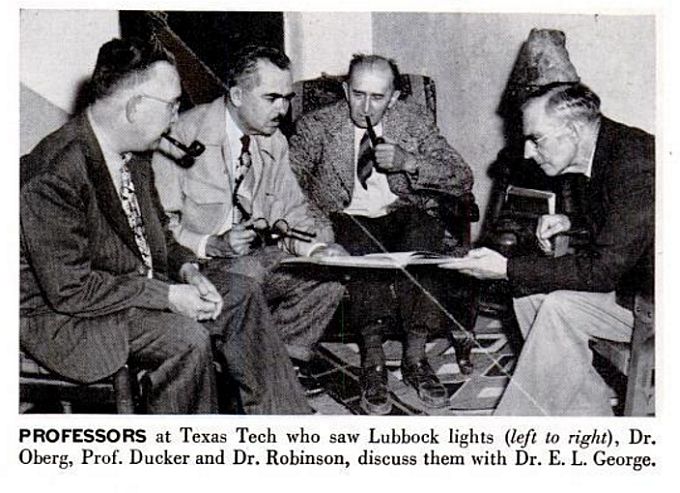
At 9:10 p.m. on Aug. 25, 1951, Dr. W. I. Robinson, professor of
geology at the Texas technological College, stood in the back yard
of his home in Lubbock, Texas and chatted with two colleagues. The
other men were Dr. A. G. Oberg, a professor of chemical
engineering, and Professor W. L. Ducker, head of the department of
petroleum engineering. The night was clear and dark. Suddenly all
three men saw a number of lights race noiselessly across the sky,
from horizon to horizon, in a few seconds. They gave the impression
of about 30 luminous beads, arranged in a crescent shape. A few
moments later another similar formation flashed across the night.
This time the scientists were able to judge hat the lights moved
through 30 degrees of arc in a second. A check the next day with
the Air Force showed that no planes had been over the area at the
time. This was but the beginning: Professor Ducker observed 12
flights of the luminous objects between August and November of last
year. Some of his colleagues observed as many as 10. Hundreds of
nonscientific observers in a wide vicinity around Lubbock have seen
as many as three flights of the mysterious crescents in one night.
On the night of Aug. 30 an attempt to photograph the lights was
made by 18-year old Carl Hart Jr. He used a Kodak 35-mm camera at
f3.5, 1/10 of a second. Working rapidly, Hart managed to get five
exposures of the flights. The pictures exhibited by Hart as the
result of this effort show 18 to 20 luminous objects, more intense
than the planet Venus, arranged in one or a pair of crescents. In
several photographs, off to one side of the main flight, a larger
luminosity is visible –like a mother craft hovering near its
aerial brood.

EVALUATION
The observations have been too numerous and too similar to be
doubted. In addition the Air Force, after the closest examination,
has found nothing fraudulent about Hart's pictures. The lights are
much too bright to be reflections, and therefore bodies containing
sources of light. Since Professors Ducker, Oberg, and Robinson
could not measure the size and distance of the formations, they
could form no precise estimate of their speed. However they
calculated that if the lights were flying at an altitude of 5,000
feet they must then have been traveling about 1,800 mph.
The professors, along with other
scientists, agree that in order to
explain the silence of the objects, it must be assumed that they
were at 50,000 feet in the air; in which case they were going not
1,800 but 18,000 mph.
INCIDENT 2
On July 10, 1947 at 4:47 p.m., one of the U.S.'s top
astronomers was driving from Clovis to Clines Corners, N. Mex.
[Subsequently revealed to be Dr. Lincoln LaPaz, investigator of
Incident 10, the mysterious green fireballs.]
His wife and his teen-aged daughters were also in the car. (For
professional reasons he has asked LIFE to withhold identity.)
It was a bright sunny day, but the whole western half of the sky was
a "confused cloud sea." All at once, as the car headed toward these
clouds, "all four of us almost simultaneously became aware of a
curious bright object almost motionless" among the clouds.
Instantly, from long habit in dealing with celestial phenomena, he
began to make calculations. with what crude materials he had at
hand. He held a pencil at arm's length, measured the size of the
object against the windshield of the car, measured the distance
between his eyes and the windshield, etc. His wife and two
daughters did the same, each making independent calculations. The
object, says the scientist, "showed a sharp and firm regular
outline, namely one of a smooth elliptical character much harder and
sharper than the edges of the cloudlets... The hue of the luminous
object was somewhat less white than the light of Jupiter in a dark
sky, not aluminum or silver-colored.... The object clearly
exhibited a sort of wobbling motion... This wobbling motion served
to set off the object as a rigid, if not solid body." After 30
seconds in plain view, the ellipsoid moved slowly behind a cloud
(273 degrees azimuth, elevation 1 degree) "and we thought we had
lost it." But approximately five seconds later it reappeared (275
degrees azimuth, elevation 2 degrees). "This remarkably sudden
ascent thoroughly convinced me that we were dealing with an
absolutely novel airborne device." After reappearing, the object
moved slowly from south to north across the clouds. "As seen
projected against these dark clouds, the object gave the strongest
impression of self-luminosity." About two and a half minutes after
it first came into view, the thing disappeared finally behind a
cloudbank.
EVALUATION
The astronomer vouches for the approximate accuracy of his
observations and computations. He determined that the object was
not less than 20 nor more than 30 miles from his viewing point; that
it was ellipsoidal and rigid; that it was 160 feet long and 65 feet
thick, if seen at minimum distance; or 245 feet long and 100 feet
thick if at maximum; and that its horizontal speed ranged between
120 and 180 mph and its vertical rise between 600 and 900 mph. He
also observed that the object moved with a wobble, no sounds, and
left no exhaust or vapor trail. His wife and daughters support his
observations, and their computations were in accordance with his
own, though slightly less conservative. The object's appearance and
behavior answer no known optical or celestial phenomenon. No known
or projected aircraft, rocket or guided missile can make such a
rapid vertical ascent without leaving an exhaust or vapor
trail.
INCIDENT 3
On April 24, 1949 at 10:20 a.m., a group of five technicians under
the general supervision of J. Gordon Vaeth, an aeronautical engineer
employed by the Office of Naval Research, were preparing to launch a
Skyhook balloon near Arrey, N. Mex. A small balloon was sent up
first to check the weather. Charles B. Moore Jr., an aerologist of
General Mills Inc. (pioneers in cosmic ray research) was tracking
the weather balloon through a theodolite – a 25-power
telescopic instrument, which gives degrees of azimuth and elevation
(horizontal and vertical position) for any object it is sighted on.
At 10:30 a.m. Moore leaned back from the theodolite to glance at
the balloon with his naked eye. Suddenly he saw a whitish
elliptical object, apparently much higher than the balloon, and
moving, in the opposite direction. At once he picked the object up
in his theodolite at 45 degrees of elevation and 210 degrees of
azimuth, and tracked it east at the phenomenal rate of 5 degrees of
azimuth-change per second as it dropped swiftly to an elevation of
25 degrees. The object appeared to be an ellipsoid roughly two and
a half times as long as it was wide. Suddenly it swung abruptly
upward and rushed out of sight in a few seconds. Moore had tracked
it for about 60 seconds altogether. The other members of his crew
confirmed his report. No sound was heard, no vapor trail was seen.
The object, according to rough estimations by Moore and his
colleagues, was about 56 miles above the earth, 100 feet long and
was traveling at seven miles per second.
EVALUATION
No known optical or atmospheric phenomenon fits the facts. A
natural object traveling at seven miles per second has never been
seen to make a sudden upward turn. There is no known or projected
source of silent, vaporless power for such a machine. No human
being could have borne the tremendous "G" load brought to bear on
the craft during its abrupt vertical veer.
INCIDENT 4
One night in the summer of 1948 [August 20, 1949]
Clyde W. Tombaugh, the discoverer of
the planet Pluto, was sitting in the back yard of his home at Las
Cruces, N. Mex. With him were his wife and his mother-in-law. It
was about 11 p.m. and they were all sitting quietly, admiring the
clarity of the southwestern sky, like any proper astronomical
family. All at once they all saw something rush silently overhead,
south to north, too fast for a plane, too slow for a meteor. It
seemed to be quite low. All three of the witnesses agreed that the
object was definitely a solid "ship" of a kind they had
never seen before. It was of an oval shape and "seemed to
trail off at the rear into a shapeless luminescence." There was
a blue-green glow about the whole thing. About half a dozen
"windows" were clearly visible at the front of the ship
and along the side. They glowed with the same blue-green color as
the rest of the ship, only the glare was brighter, and had a touch
of yellow in it.
EVALUATION
The object bore a resemblance to the craft seen by Pilots Chiles
and Whitted. It bore resemblance to no aircraft known to be in operation
on earth.
On the night of Nov. 2, 1951 a ball of kelly-green fire, larger
than the moon, and blazing several times more brightly, flashed
eastward across the skies of Arizona. It raced, straight as a
bullet, parallel to the ground, and then exploded in a frightful
paroxysm of light — without making a sound. At least 165 people
saw the incredible thing; hundreds more witnessed the similar flight
of countless other fireballs that since December 1948 have bathed
the hills of the Southwest in their lunar glare. In the last year
they have been seen as far afield as Pennsylvania, Maryland and
Puerto Rico. The chief Air Intelligence officer for the Albuquerque
district saw one. Colonel Joseph D. Caldara, USAF, attached to the
Joint Chiefs of Staff, saw one in Virginia. Hundreds of pilots,
weather observers and atomic scientists have sighted them. Reports
came so thick and fast during 1948 that in 1949 [April 1, 1950] the
Air Force established "Project Twinkle" to investigate them. Project
Twinkle established a triple phototheodolite post at Vaughn, N. Mex. to
obtain scientific data on the fireballs. Day and night, week in,
week out, for three months [six months], a crew kept vigil.
Ironically, while fireballs continued flashing everywhere else in the
Southwest, they saw nothing until the project was transferred to the
Holloman Air
Force Base at Alamogordo, N. Mex. There, during another three-months
siege, they saw a few but were unable to make satisfactory
computations because of the fireballs' great-speed. Search parties
have had no better luck. They have combed in vain the countryside
beneath the point of disappearance; not a trace of telltale
substance has been found on the ground.
EVALUATION
The popular Southwest belief that a strange meteor shower was
underway has been blasted by Dr. Lincoln LaPaz, mathematician,
astronomer and director of the Institute of Meteoritics at the
University of New Mexico. He points out that normal fireballs do
not appear green, they fall in the trajectory forced on them by
gravity, are generally noisy as a freight train, and leave
meteorites where they hit. The green New Mexican species does none
of these things. Neither do the green fireballs appear to be
electrostatic phenomena – they move too regularly and too
fast
If the fireballs are the product of a U.S. weapons project, as
some Southwesterners believe, it is a very secret one indeed: the
Atomic Energy Commission and every other government agency connected
with weapons development has denied to LIFE any responsibility for
the fireballs.
Could they be self-destroying Russian reconnaissance devices? Not
likely. While the U.S. believes the Russians have an intercontinental guided
missile, there is no intelligence that indicates they have developed silent
power plants or objects capable of moving nearly as fast as meteors (12
miles a second). Yet – for whatever it may be worth – the
only reports of green fireballs prior to 1948 came from the Baltic
area.
If the fireballs do not respond to gravity, they could only be
explained as lighter-than-air craft or electrical phenomena –
but they have characteristics which rule these out. Therefore they
must be propelled. If propelled and not natural phenomena, they
must be artificial. The extreme greenness of the fireballs has
impressed most witnesses. When asked to indicate the approximate
color on a spectrum chart, most of them have touched the band at
5,200 angstroms, close to the green of burning copper. Copper is
almost never found in meteorites; the friction of the air oxidizes
it shortly after the meteor enters the upper atmosphere. However, a
curious fact has been recorded by aerologists. Concentrations of
copper particles are now present in the air of Arizona and New
Mexico, particularly in "fireball areas." These were not encountered
in air samples made before 1948.
WHAT THEY ARE NOT – AND WHAT THEY MAY BE
What are the flying saucers, the luminous fuselages, the foo
fighters and the green fireballs? The answer – if any answer at
this time is possible – lies in the field of logic rather than of
evidence. What the things are may be adduced partially by reviewing
what they are not.
THEY ARE NOT PSYCHOLOGICAL PHENOMENA. Although the Air Force
cheerily wrote off its 34 unexplained incidents with this pat
theory, the explanation does not hold up. There is no evidence,
beyond textbook speculation, for such a supposition, and there is
the direct evidence already cited against it. To doubt the
observers in the foregoing cases is to doubt the ability of every
human being to know a hawk from a handsaw.
THEY ARE NOT THE PRODUCT OF U.S. RESEARCH.
LIFE investigated this possibility to exhaustion. Not fully
satisfied by the public denials of President Truman, Secretary
Johnson and others, the investigators put the question directly to
Gordon Dean, chairman of the Atomic Energy Commission. He said:
"There's nothing in our shop that could account for these things,
and there's nothing going on that I know of that could explain
them." Still unconvinced, LIFE checked the whereabouts and
present business of every scientist who might have anything to do
with the development of superaircraft. All were accounted for in
other ways. Careful feelers through the business and labor world
encountered no submerged projects of the immensity necessary to
build a fleet of flying disks. And there is still the conclusive
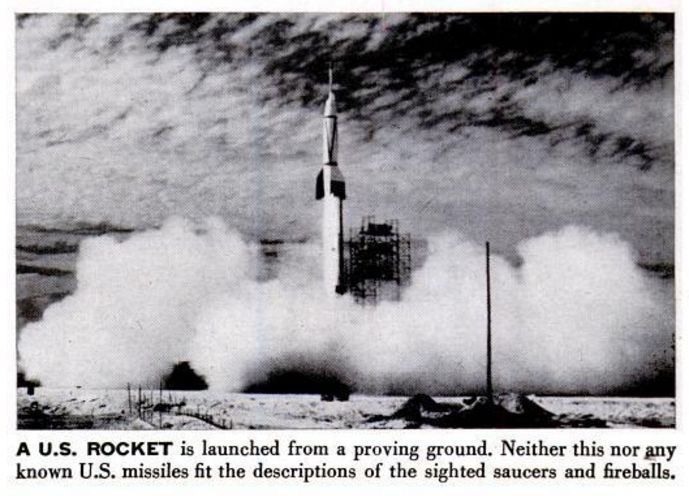
fact: U.S. science has at its command no source of power that could
put a flying machine through such paces as the saucers perform.
THEY ARE NOT A RUSSIAN DEVELOPMENT. It is
inconceivable that the Russians would risk the loss of such a
precious military weapon by flying a saucer over enemy territory.
No man-made machine is foolproof; sooner or later one would crash in
the U.S. and the secret would be out. Nor is there any reason to
believe that Russian science, even with German help, has moved
beyond not only the practical but the THEORETICAL horizons of U.S.
research.
THEY ARE NOT DISTORTIONS OF THE ATMOSPHERE RESULTING FROM ATOMIC
ACTIVITY. To quote the answer David Lilienthal, former
AEC commissioner, once made to that suggestion: "I can't prevent
anyone from saying foolish things." Nor are they aberrations of the
northern lights. Magnetic disturbances cannot account for them and
neither can a notion (recently fathered by Dr. Urner Liddel, the
Navy physicist) that they are "vertical mirages" – reflections from
a vertical (instead of a horizontal) layer of heated air.
THEY ARE NOT SKYHOOK BALLOONS. This was the original
Liddel explanation, and in a few instances it may have been correct.
But not many. They could scarcely be "fireflies in the cockpit," as
one Air Force colonel suggested, since most of the observers were
not in a cockpit when they saw their saucers. And it is hard to
believe that saucers could be the reflections of automobile
headlights on clouds, when they are seen in daylight under cloudless
skies. These being the dead-end alleys of negative evidence, is
there hope of an explanation on the open avenues of scientific
theory? The answer is yes.
The rank of science has taken the saucers far more seriously than
the file of laymen and, after five years of close watch on all
reports, a number of scientists were ready with some conclusions.
One of these was Dr. Walther Riedel, once chief designer and
research director at the German rocket center in Peenemunde, now
engaged on secret work for the U.S. Dr. Riedel has never seen a
saucer himself, but for several years he has kept records of saucer
sightings all over the world. He told LIFE: "I am completely
convinced that they have an out-of-world basis."
Dr. Riedel has four points to his argument: "First, the skin
temperatures of structures operating under the observed conditions
would make it impossible for any terrestrial structure to survive.
The skin friction of the missile at those speeds at those altitudes
would melt any metals or nonmetals available.
"Second, consider the high acceleration at which they fly and maneuver
... In some descriptions the beast spirals straight up. If you think of
the fact that the centrifugal force in a few minutes of such a maneuver
would press the crew against the outside, and do likewise to the blood,
you see what I mean.
"Third.... There are many occurrences where they have done things that
only a pilot could perform but that no human pilot could stand.
"Fourth, in most of the reports there is a lack of visible jet. Most
observers report units without visible flame...and no trail. If it would
be any known type of jet, rocket, piston engine, or chain-reaction motor,
there would be a very clear trail at high altitude. It is from no power
unit we know of..."
Dr. Riedel's arguments are reinforced by those of Dr. Maurice A.
Biot, one of the leading aerodynamicists in the U.S. and a
prominent mathematical physicist. From an aerodynamical viewpoint,
says Dr. Biot, the saucer shape makes very little sense if the
machine is to travel in the atmosphere. A disk has a high drag and
is a poor airfoil unless stabilized; when whirled at high speed
through the air, it "wobbles" distressingly – a movement
observed in several of the saucers sighted. However, for space
travel, where there is no atmosphere to oppose, the disk has
significant advantages. The sphere, theoretically better, presents
several difficult problems of construction and utilization. The
disk, easier to build, has almost all the virtues of the sphere and
some of its own. Reviewing the evidence presented here, Dr. Biot
said: "The least improbable explanation is that these things are
artificial and controlled. . .My opinion for some time has been
that they have an extraterrestrial origin."
WHO? WHAT? AND WHEN?
There, at least, is a plausible explanation of the disk shape. But the
real depths of the saucer mystery bemuse penetration, as the night sky
swallows up a flashlight beam. What of the other shapes? Why do the things
make no sound? How to explain their eerie luminosity? What power urges
them at such terrible speeds through the sky? Who, or what, is aboard?
Where do they come from? Why are they here? What are the intentions of
the beings who control them?
Before these awesome questions, science – and mankind –
can yet only halt in wonder. Answers may come in a generation
– or tomorrow. Somewhere in the dark skies there may be those
who know.
|
|
|||||||

|
|
|